The Harsh Truth London Food Businesses Need to Hear
If you run a restaurant, café, pub kitchen, hotel kitchen, or any food business in London, there is one question that should keep you focused every single week: is my kitchen genuinely deep clean, or does it just look clean?
There is a massive difference. A kitchen that looks clean on the surface can be hiding weeks of grease build up inside extraction canopies, layers of carbon baked onto oven walls, bacteria multiplying in floor drains, and mould quietly growing behind refrigeration units. None of that is visible during a quick wipe down after service. But all of it will be visible and documented when an Environmental Health Officer (EHO) walks through your door for an unannounced inspection.
In London alone, a commercial kitchen extraction system catches fire on average once every nine days. Across the UK, kitchen ductwork fires cost insurers around £65 million a year in claims. And behind most of those fires is the same cause: grease that was never properly removed because the kitchen was never properly deep cleaned.
We exists to fix that. Whether you manage a busy restaurant in Soho, a hotel kitchen in Kensington, a school canteen in Hackney, or a café in Camden this is the definitive, London specific guide on how to deep clean a commercial kitchen the right way.
What Does “Deep Clean” Actually Mean for a Commercial Kitchen?
Before anything else, let us be clear about what a commercial kitchen deep clean actually is because “deep clean” is one of the most overused and misunderstood terms in the food industry.
A deep clean is not a thorough end of service clean. It is not your kitchen team staying late on a Friday to scrub the hob and mop the floor. Those are essential daily tasks, but they are maintenance cleaning they address the surface layer of contamination from that day’s service. They do not reach the accumulated grease, carbon, biological residue, limescale, and bacteria that build up over weeks and months inside equipment, behind appliances, inside ducts, and in the spaces your staff never reach.
Nightly cleaning by kitchen staff addresses immediate surface contamination after each service it does not constitute the deep cleaning required to maintain a commercial kitchen to a food safe standard over time. Professional commercial kitchen cleaning provides documented evidence of compliance that satisfies EHOs, insurers, and landlords.
A true commercial kitchen deep clean involves trained operatives using specialist industrial grade degreasers, steam cleaning equipment, pressure washers, and purpose made tools to strip every surface, every appliance component, every extraction filter, every drain, and every hard to reach area back to a genuinely clean, food safe, bacteriologically safe state and then producing documented evidence that this has been done.
That last part matters more than most London food business owners realise.
Why This Matters More in London Than Anywhere Else
London is the most inspected, most scrutinised food business environment in the United Kingdom. The city’s 33 local authorities each run active Environmental Health teams that conduct both routine and unannounced inspections under the Food Hygiene Rating Scheme. The average fine for a London food business that fails an Environmental Health inspection for poor kitchen hygiene is £3,000 or more. And 60% of London restaurant kitchen fires are caused by grease build up in extraction systems the area chefs almost never clean.
London’s food business density is unlike anywhere else in the UK. Competition for customers is fierce, and a low food hygiene rating displayed in your window or worse, a closure notice can end a business in weeks. Following inspection by the local authority, a business is rated on a scale of 0 to 5. The lowest rating of 0 means urgent improvement is required, while the top rating of 5 means hygiene standards are very good. That rating is publicly visible online, on the FSA website, and increasingly being checked by London diners before they book or walk in.
The stakes could not be higher. A properly maintained, professionally deep cleaned kitchen is not an expense it is protection for your licence, your reputation, and your business. Commercial Kitchen Cleaning vs Restaurant Kitchen
How Often Should You Deep Clean a Commercial Kitchen in London?
This is one of the most searched questions on Google by London food business owners, and it deserves a precise, honest answer rather than a vague “it depends.”
Most commercial kitchens should be professionally deep cleaned every six months as a baseline. Heavy use kitchens running 12 to 16 hours daily need quarterly cleaning, while light use venues can extend to a longer interval but should never go beyond six months without a comprehensive deep clean.
Here is how that breaks down for different London kitchen types:
- High volume London restaurants, fast food operations, and hotel kitchens (operating 12–16 hours per day): full professional deep clean every 3 months, with TR19-compliant extraction cleaning quarterly.
- Mid volume restaurants, cafés, and pub kitchens (operating 6–12 hours per day): professional deep clean every 6 months, with extraction cleaning at least twice yearly.
- Light use kitchens community halls, small cafés, seasonal venues (operating 2–6 hours per day): professional deep clean every 6–12 months, with extraction cleaning annually.
For fast food restaurants or those that frequently use a deep fat fryer, deep cleaning of vents and hoods should take place once every 30 days. For restaurants that do not use a deep fat fryer every day, a minimum of once every 90 days is recommended.
The moment you’re unsure which category your kitchen falls into, book a site assessment. An experienced commercial kitchen cleaning specialist in London will assess your usage, your extraction system, and your risk profile and recommend the right schedule not guess at it.
Step by Step How to Deep Clean a Commercial Kitchen (The Professional Method)
This is the section most guides get wrong. They present a simplified checklist that sounds thorough but misses the professional standard required for genuine compliance. What follows is the real process used by trained commercial kitchen cleaning operatives.
Step 1 Pre Clean Assessment and Safety Preparation
Before any cleaning begins, the kitchen must be properly prepared. All cooking equipment is powered down and allowed to cool to a safe temperature. All food items are removed or covered and stored safely. Cleaning operatives put on the appropriate PPE heavy duty chemical resistant gloves, goggles, and protective aprons because the degreasers and sanitisers used in commercial kitchen deep cleaning are industrial strength products, not household sprays.
A zone plan is established: clean zones for disassembled components waiting to be cleaned or already cleaned, and dirty zones for active scrubbing. This prevents cross contamination during the cleaning process itself. Cleaning schedules, deep clean frequency, and verification records are integral to HACCP. When an EHO asks to see your cleaning diary, you should be able to produce it on the spot. This preparation stage is also when the cleaning record for this session begins date, time, operative, chemicals used, and areas covered.
Step 2 Top Down Cleaning: Ceilings, Canopies, and Walls
Every professional kitchen deep clean works strictly from the top of the room downwards. The ceiling, any exposed beams, light fixtures, and ventilation grilles above cooking zones are wiped down first to remove the grease film that floats up from cooking surfaces and settles on every overhead surface. In a busy London kitchen, this layer can be substantial and is a genuine fire risk.
Then come the extraction canopies the steel hoods directly above your cooking line. These are the most grease intensive surfaces in any commercial kitchen. Filters should be soaked in a heavy duty degreaser or run through a commercial dishwasher, and hood interiors must be cleaned thoroughly to remove all accumulated grease. This is not optional. It is a fire safety requirement, a food hygiene requirement, and an insurance requirement simultaneously.
The walls, particularly the splashback areas behind cooking equipment, receive a full application of non toxic degreaser. This is applied from top to bottom, left to stand to break down grease bonds, and then scrubbed and rinsed. Grout lines in tiled kitchen walls require particular attention, as they trap bacteria and grease in ways that surface wiping cannot address.
Step 3 Equipment Disassembly and Deep Degreasing
This is the most time consuming stage of a professional commercial kitchen deep clean, and it’s the stage that most self performed kitchen cleans skip entirely usually because it takes skill, time, and specialist chemicals to do properly.
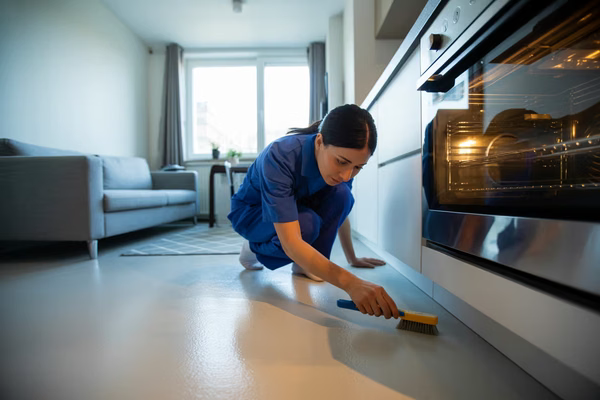
Every piece of cooking equipment is disassembled to the extent possible. Oven racks and trays are removed and soaked in hot water with industrial degreaser. The oven interior is treated with professional oven cleaner, left to penetrate baked on carbon and grease, then scrubbed methodically with purpose made brushes and scrapers, and rinsed thoroughly to remove all chemical residue. Fryers are drained, the basket and interior are cleaned with degreaser, and all grease ports are cleared. Grills, griddle plates, salamanders, and hot plates are scraped, degreased, and polished. Behind and under equipment must be cleaned using extension tools and brushes to reach these areas properly these are the zones where grease accumulates most heavily and poses the greatest fire risk.
Refrigeration units are emptied, shelves and drawers removed and washed, interiors sanitised, door seals cleaned (a common place for mould growth), and temperature checked before restocking. Bain maries, steamers, dishwashers, and coffee equipment all receive the same methodical treatment.
Step 4 Extraction Ductwork TR19 Compliance
Extraction ductwork cleaning is the area of commercial kitchen deep cleaning most often misunderstood by London food business owners and the one that carries the most serious consequences when neglected.
TR19 is a guidance document developed by the BESA (Building Engineering Services Association) that outlines industry best practices for cleaning ventilation systems, particularly in commercial kitchens. TR19 compliance is essential for reducing fire hazards from grease laden ducts, meeting insurance requirements, passing Environmental Health inspections, and supporting your Food Standards Agency hygiene rating.
TR19 ductwork cleaning requires GHT (Grease Hygiene Technician) qualified operatives with access equipment and specialist industrial tools. The ductwork is inspected, grease deposit thickness is measured, the ducts are cleaned to the required standard, and a pre and post clean report with photographs is produced. Insurers are steadily tightening the evidence they require before paying out on fire claims it is not enough for the chef to wipe the surfaces. The responsible person must be able to prove that every grease bearing element has been cleaned to a recognised standard, on a recognised schedule, by a competent contractor.
If your insurer requires TR19-compliant extraction cleaning and you cannot produce the documentation, your insurance policy may be invalid. That is not a risk any London food business can afford to carry.
Step 5 Floors, Drains, and Below Equipment Areas
Kitchen floors are among the most bacteria laden surfaces in any food business. They collect food particles, fat, biological waste, and cleaning chemical residue from every service and the areas underneath and behind fixed equipment are where the most severe accumulation builds up.
A professional deep clean involves moving or reaching underneath all equipment to clean the floor areas that routine mopping never touches. Floor drains are unblocked, flushed, and sanitised blocked or poorly maintained drains are one of the most common hygiene failures noted by EHOs during inspections. Drains should be cleaned every couple of weeks with a professional grade drain cleaner and then flushed with hot water to remove any blockages and ensure a hygienic sink area. During a deep clean, drains receive the most intensive attention.
Floors are mopped with an appropriate floor cleaner for the surface type non slip kitchen flooring requires specific products that clean effectively without degrading the anti slip texture. Grout lines in tiled kitchen floors are scrubbed separately.
Step 6 Sinks, Taps, Handwashing Stations, and Sanitary Areas
Every sink basin, tap fitting, and handwashing station is scrubbed, disinfected, and descaled. Limescale build up around taps and sink outlets is treated with an appropriate acid descaler. Soap dispensers and paper towel holders surfaces that food operatives touch constantly, often with unwashed hands are disinfected thoroughly.
Step 7 Final Sanitisation, ATP Testing, and Documentation
Once all cleaning is complete, every food contact surface worktops, prep tables, chopping boards, equipment surfaces is sanitised with a product that meets BS EN 1276 or BS EN 13697, the standards required by the Food Standards Agency for disinfectants and sanitisers used on food contact surfaces.
For professional commercial kitchen deep cleaning, the final stage includes ATP (adenosine triphosphate) swab testing a rapid test that measures biological residue on surfaces to verify that the cleaning has been effective to a measurable standard. This test result is included in the cleaning documentation. A completed deep clean contract with a competent external provider showing scope, frequency, and TR19 standards, dated TR19 pre and post clean reports with photographs and grease deposit readings, and a current Hygiene Rating certificate must all be readily available during an EHO inspection.
The Commercial Kitchen Cleaning Checklist: What EHOs Expect to See
When an EHO visits your London kitchen announced or unannounced they are not just looking at whether the surfaces appear clean. They are auditing your entire food safety management system. Here is exactly what they expect to find documented and in order: and Same Day Kitchen Cleaning Services in London guide
- Written cleaning schedule specifying what is cleaned, at what frequency, by whom, using which products and methods
- Completed daily cleaning diary signed off by a supervisor at the end of every service
- Deep clean contract records with a competent external provider, showing scope, frequency, and TR19 compliance
- COSHH documentation for every cleaning chemical used on the premises
- TR19 pre- and post clean reports with photographs and grease deposit readings, dated and signed
- ATP swab test results demonstrating surface cleanliness to a measurable standard
- Food hygiene rating certificate displayed visibly at the premises
A business that cannot produce written cleaning records will be scored down under the Food Hygiene Rating Scheme regardless of how clean the kitchen appears on the day of the visit. The documentation is not a formality it is evidence of the system, and without it, even a spotless kitchen can receive a poor rating.
Common Mistakes London Kitchens Make During Deep Cleaning
Even well intentioned kitchen teams make the same mistakes repeatedly when attempting to deep clean without professional support. Understanding these mistakes is the first step to avoiding them.
The single most common mistake is cleaning from the bottom up starting with the floors and working upward. This means every ceiling wipe, every canopy scrub, and every wall clean drops grease and debris back onto surfaces that have already been cleaned, making the entire process inefficient and incomplete. Always work top to bottom.
The second most common mistake is using domestic or non food safe cleaning products. Disinfectants and sanitisers used on food contact surfaces must meet BS EN 1276 or BS EN 13697 these are the benchmarks EHOs use when assessing whether your cleaning regime is adequate. Domestic products do not meet this standard and will not satisfy an inspection.
The third mistake is neglecting the extraction system. As covered above, this is both a fire risk and a compliance failure. 60% of London restaurant kitchen fires are caused by grease build up in extraction systems. No kitchen team armed with cloths and degreasers can properly clean the ductwork behind and above the canopy this requires specialist equipment and certified operatives.
The fourth mistake is failing to keep records. Without a cleaning diary and documented professional deep cleans, you have no evidence of compliance even if your kitchen is genuinely in excellent condition.
Why London Food Businesses Choose Professional Kitchen Cleaners
Managing a commercial kitchen deep clean in house is possible for some routine tasks, but the full professional standard the one that satisfies EHOs, insurance requirements, and TR19 compliance requires specialist knowledge, specialist equipment, and specialist products that a kitchen team simply does not have access to.
Preparing for an unannounced EHO inspection is not about last minute cleaning it is about consistency, documentation, and professional support. By combining strong daily routines with a planned commercial kitchen deep clean, facilities managers can maintain genuine audit readiness at all times.
Professional commercial kitchen cleaning operatives in London understand the specific regulatory requirements that apply here. They know what EHOs look for, they produce the documentation that compliance requires, and they use industrial equipment that reaches the areas kitchen staff never can. For London’s food businesses, working with a trusted professional cleaning partner is not a luxury it is the most practical and cost effective way to stay compliant, stay insured, and protect a business they have worked hard to build.
Book Your Commercial Kitchen Deep Clean in London Today
Is your kitchen genuinely deep clean and inspection ready? Or are you carrying compliance risk you don’t even know about?
SAFA Cleaning Services provides professional commercial kitchen deep cleaning across London from Central London restaurants to outer borough hotel kitchens and everything in between. Our trained operatives work to TR19 standards, use food safe industrial cleaning products, and produce full cleaning documentation for your compliance records.
Don’t wait for an EHO inspection to find out what you’ve been missing. Contact SAFA Cleaning Services today and book your professional commercial kitchen deep clean.
Serving all London boroughs from the City and West End to South, East, and North London
Frequently Asked Questions Commercial Kitchen Deep Cleaning London
Q1: How often should a commercial kitchen in London be professionally deep cleaned?
The baseline is every 6 months for moderate use kitchens. High volume London restaurants and hotel kitchens operating 12+ hours daily need a full professional deep clean every 3 months, with TR19 extraction cleaning quarterly. Light use venues can extend to annually, but should never exceed 6 months between professional cleans.
Q2: Is commercial kitchen deep cleaning a legal requirement in London?
While the law does not prescribe a specific deep cleaning frequency by name, regular kitchen deep cleaning is a critical component of food hygiene regulations as enforced by local authorities, fire safety legislation, and TR19 compliance for ventilation hygiene. Failure to demonstrate a documented cleaning regime can result in a poor Food Hygiene Rating, a Hygiene Improvement Notice, or prosecution under the Food Safety Act 1990.
Q3: What is TR19 compliance and does my London kitchen need it?
TR19 is the Building Engineering Services Association (BESA) standard for cleaning commercial kitchen extraction and ventilation ductwork. TR19 is referenced in commercial leases, insurance policies, and fire risk assessments so consistently that treating it as mandatory is the only sensible course for any London food business. If your insurer requires it and you cannot evidence compliance, your policy may be invalid.
Q4: Can my kitchen team deep clean the kitchen themselves?
Your team can and should maintain daily and weekly cleaning routines. But the professional standard required for EHO compliance, TR19 certification, food safe sanitisation, and documented deep cleaning cannot be achieved with kitchen equipment and household products. It requires trained specialist operatives with industrial tools and certified cleaning agents.
Q5: What happens if my kitchen fails a London EHO inspection?
A failed inspection results in a low Food Hygiene Rating displayed publicly at your premises and on the FSA website. Depending on the severity, you may receive a Hygiene Improvement Notice requiring specific remedial action within a set timeframe, or in serious cases, a Hygiene Emergency Prohibition Notice which means immediate closure. London food businesses have a maximum of 72 hours to remediate critical hygiene failures before a second unannounced inspection.
Q6: How long does a professional commercial kitchen deep clean take?
Timing depends on the size and condition of your kitchen. A small café kitchen typically takes 4–6 hours. A full restaurant kitchen with extraction cleaning takes 8–12 hours. Large hotel or institutional kitchens may require a full day or an overnight session. Most London cleaning companies schedule deep cleans outside service hours overnight or on a Monday closure to avoid business disruption.
Q7: Do you cover kitchen cleaning near me in London?
Yes. SAFA Cleaning Services covers all London boroughs and postcodes, including Central London, North, South, East and West London, and all areas within the M25. If you’re searching for commercial kitchen cleaning near me in London, we’re here. Visit contact us to get in touch.
Q8: What documentation will I receive after a professional kitchen deep clean?
After every professional deep clean, you should receive a signed cleaning record specifying the date, operatives, areas cleaned, products used, and any observations or recommendations. If TR19 extraction cleaning is included, you receive pre- and post clean reports with photographs and grease deposit readings. ATP swab test results are provided on request. These documents go straight into your HACCP file and are ready for your next EHO inspection.