Your builders have packed up and gone. The kitchen is in. The walls are painted. It looks like the job is done.
But it is not done. Not yet.
There is a fine grey film on every surface. You wipe it. An hour later it is back. You hoover the floor. The air smells chalky. Your throat feels tight and dry.
That dust is not normal house dust. Much of it is silica dust. And silica dust can hurt your lungs.
This guide explains what silica dust is. It explains why London homes get hit harder than most. And it explains how proper silica dust removal post build cleaning London actually works. No jargon. No sales talk. Just what you need to know.
0.1 mg/m³ The legal HSE workplace exposure limit for respirable crystalline silica over an 8-hour day.
100x smaller than a grain of sand That is how small respirable silica particles are. You cannot see them at all.
What Is Silica Dust, and Why Does It Matter?
Silica is a natural mineral. It is in sand. It is in stone. It is in concrete, brick, mortar and tile.
On its own, in a solid block, silica is harmless. You can hold a brick all day and be perfectly fine.
The problem starts when someone cuts it. Or drills it. Or grinds it. Or sands it.
That breaks the silica into tiny pieces. The smallest pieces are called respirable crystalline silica, or RCS. “Respirable” just means small enough to breathe deep into your lungs.
Your nose and throat catch big dust. They cannot catch RCS. It slips straight past. It settles in the deepest part of your lungs. And your body cannot clear it out again.
Over years, that can cause silicosis, chronic obstructive pulmonary disease and lung cancer. The HSE calls silica the second biggest cause of lung disease in construction. Only asbestos is worse.
Why You Cannot See the Dangerous Part
Here is the part that catches almost everyone out.
The dust you can see is not the dust that harms you.
Visible dust is heavy. It falls fast. It lands on your worktop. You wipe it away and feel better.
RCS behaves differently. It is so light that it floats. It can hang in the air for hours. In a closed London flat with the windows shut, it can drift for days.
So a room can look spotless and still be full of silica. That is the whole problem in one sentence.
Which Building Materials Hold the Most Silica
Some materials are far worse than others:
Sandstone and sand up to 90% silica
Concrete and mortar roughly 25% to 70%
Granite and quartz worktops roughly 20% to 45%
Brick and block roughly 5% to 30%
Plasterboard very low silica, but the joint compound dust still irritates
Now think about a normal London renovation. Chasing walls for new wiring. Cutting a quartz worktop to fit. Drilling old brick for a new opening. Lifting old floor tiles. Every one of those jobs makes silica dust
Why London Homes Get Silica Dust Worse Than Most
This is where generic UK cleaning advice falls down. London is not like the rest of the country. Three things make it harder here.
Victorian Terraces, Lime Mortar and Floorboard Gaps
London is full of Victorian and Edwardian homes. Islington, Hackney, Camden, Wandsworth, Lambeth and Tower Hamlets are packed with them.
These houses were built differently. They used lime mortar, not modern cement. Lime mortar is very sandy, and sand is nearly all silica. So when a builder chases a wall in a Victorian terrace, the dust is far worse than in a new build.
They also have lath and plaster ceilings and original floorboards with gaps between them.
Those gaps matter more than people think. Silica dust falls straight through them. It settles in the void under the floor. Then every time you walk across the room, a small puff comes back up.
This is why some London homes still feel dusty months after the work finished. The dust was never removed. It just moved somewhere you could not see.
London Hard Water Makes the Dust Stick
London has very hard water. In many boroughs it runs from about 300 to 400 mg per litre of calcium carbonate. That is among the hardest water in the UK.
This changes how you must clean.
If you damp wipe silica dust using plain London tap water, the water dries and leaves minerals behind. Those minerals lock the fine dust onto the surface. You get a cloudy grey haze that simply will not shift.
People then scrub harder. On new glass, new tiles or a new worktop, that causes fine scratches. We see it often. The homeowner did the right thing by wiping wet, but used the wrong water and the wrong cloth.
London air already carries traffic soot and brake dust. That is the PM2.5 and PM10 pollution you read about.
After a build, your windows are wide open for airing. That pollution drifts in. It mixes with the leftover silica and forms a greasy grey film.
Plain water will not lift a greasy film. You need the right cleaning agent for it. That is a big reason a post renovation cleaning London job is nothing like a normal weekly clean.
The Problem Changes Borough by Borough
Flats in Tower Hamlets, Southwark and Newham are often in converted or high rise buildings. Windows may be sealed or restricted. Airing is difficult, so dust stays put far longer.
Homes in Richmond, Barnet and Bromley tend to be larger. More rooms and more soft furnishings mean more places for fine dust to settle into.
Central flats in Islington, Westminster and Kensington are usually smaller, with more shared walls. Dust from one flat’s building work travels along shared voids and hallways into other homes.
Every borough has its own version of the same problem
Why a Normal Clean Does Not Remove Silica Dust
Most people reach for the household vacuum. Please do not.
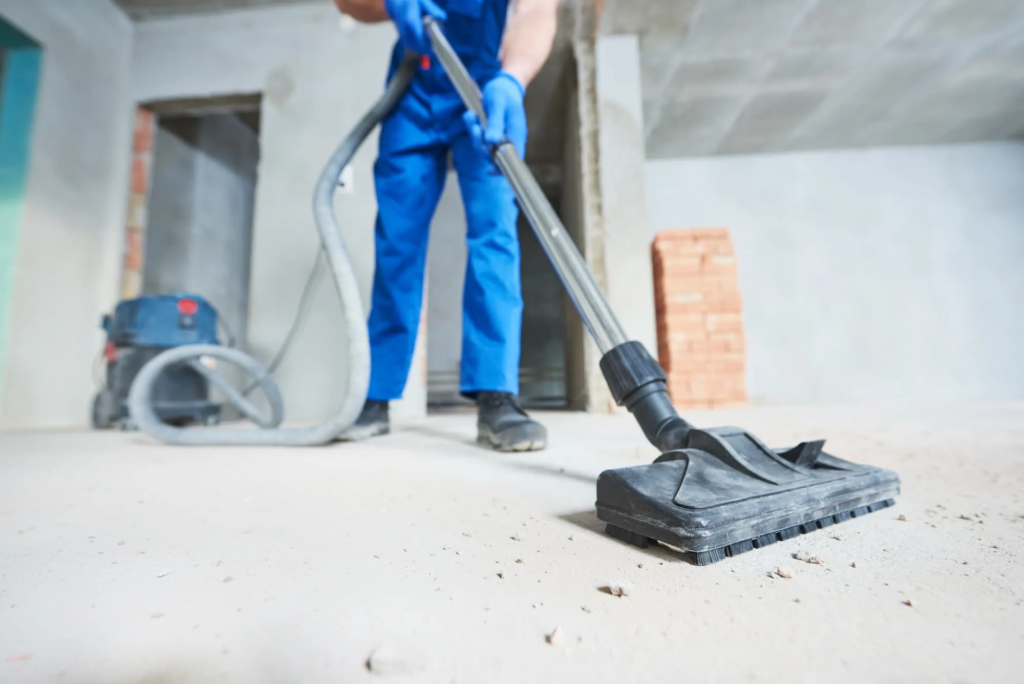
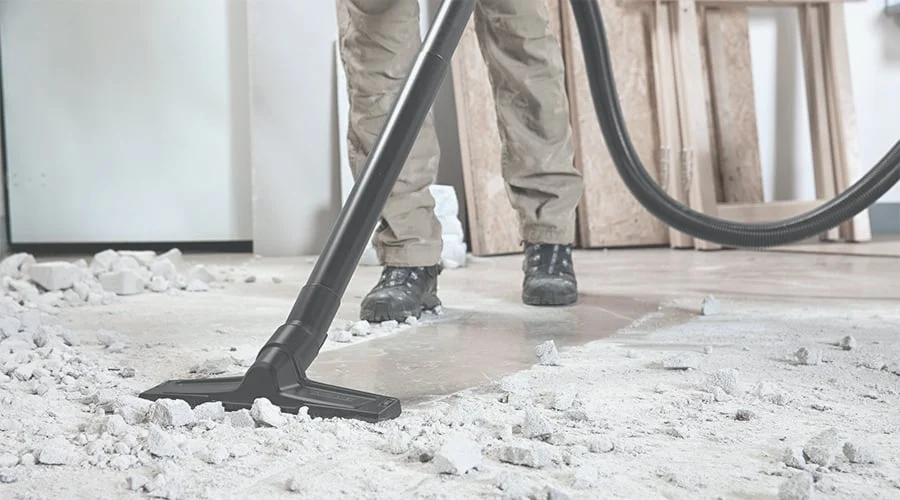
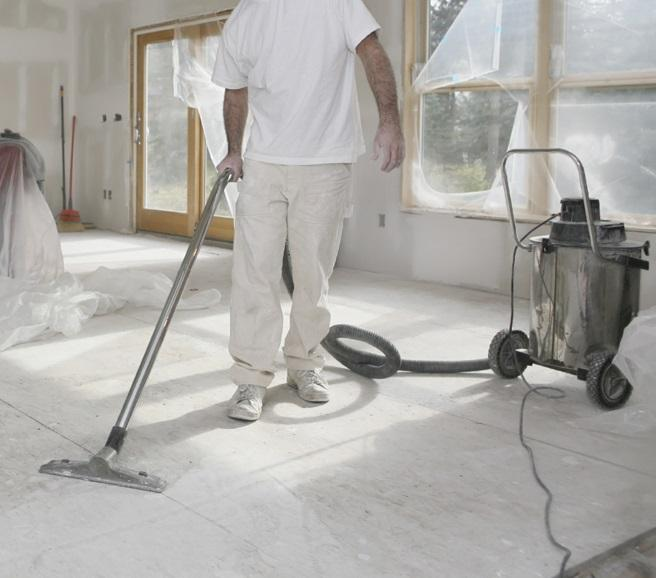
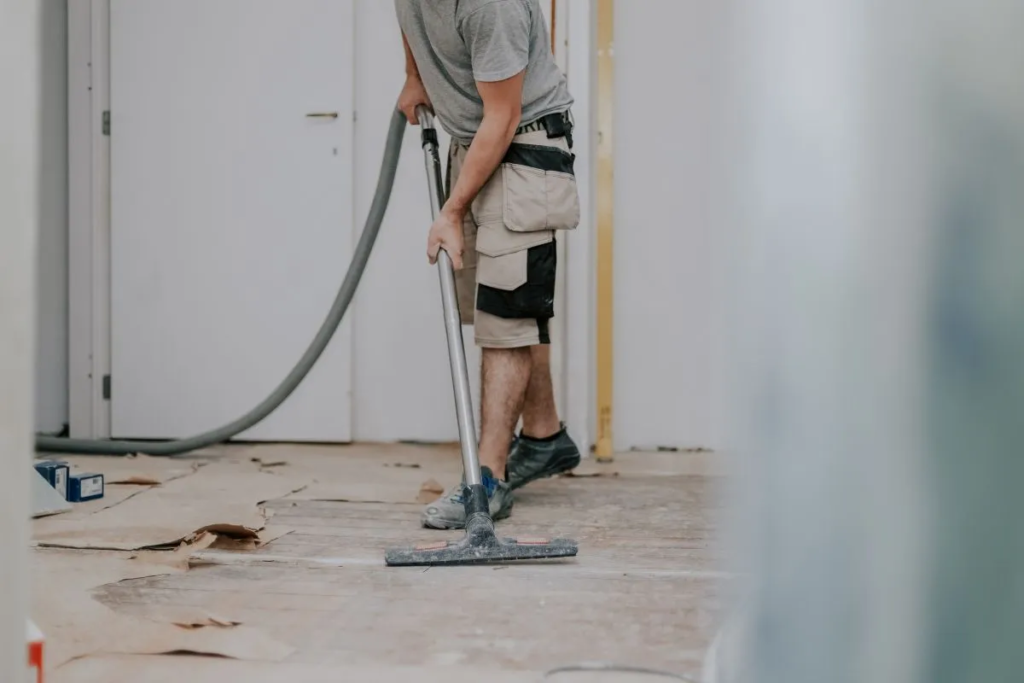
A standard domestic vacuum has a simple filter. It picks up the big bits. Then it blows the fine silica straight back into the room through its exhaust. You have not removed the dust. You have turned it into a fine mist and spread it around.
Dry sweeping is even worse. A broom lifts settled dust back into the air within seconds.
WARNING: Never dry sweep and never use a household vacuum on builder’s dust. Both push respirable silica back into the air you breathe. Never sand or scrape dried plaster or filler indoors without proper extraction either.
Professional after builders cleaning London teams work in a completely different way.
Task
DIY or Standard Clean
Professional Post Build Silica Removal
Vacuum type
Household vacuum, basic filter
M-class or H-class with H13 HEPA
Fine dust
Blown back into the room
Captured 99.95% at 0.3 microns
Order of work
Floors first, usually
Ceiling down, floors always last
Walls and ceilings
Rarely touched
Dry sponged, then damp wiped
Behind radiators
Missed
Vacuumed and flushed through
Floorboard gaps
Missed
Crevice vacuumed before sealing
Window frames
Quick wipe
Paint flecks removed, tracks vacuumed
Extract fans and vents
Missed
Cleaned, filters cleared
Water used
London hard tap water
Filtered water, changed often
Number of passes
One
Three stages across the property
New tile grout
Wiped
Grout haze removed, sealed if needed
Air quality
Left as it is
Aired and settled between stages
Time, 2-bed London flat
2 to 3 hours
6 to 10 hour
How Professional Silica Dust Removal Actually Works
The order is everything. Dust falls downwards. So you clean downwards.
First comes containment. Doors to untouched rooms are shut. Soft furnishings are covered or taken out.
Second is the dry stage. The team works from the ceiling down. Ceilings, then walls, then high ledges, then joinery, then floors. They use M-class or H-class vacuums fitted with H13 HEPA filters. An H13 filter captures 99.95% of particles at 0.3 microns. That is fine enough to trap RCS instead of spreading it.
Third is the damp stage. This only happens after the dry stage is finished. Damp wiping first would turn loose dust into a paste and smear it into the grain of brand new surfaces.
Fourth is the settle. The property is left alone, then checked again. Airborne dust disturbed during cleaning will have landed by then. There is always more. This is the stage nearly every DIY clean skips.
Fifth is the detail pass. This is the sparkle. Glass, mirrors, chrome, gloss units, tile grout, hinges, sockets and switch plates.
TIP: Ask for the three stage method in writing. One pass is never enough after a build. The dust that settles overnight after a single clean is exactly the dust that makes people think the clean failed.
A sparkle clean London job is the final stage. It is the clean that makes a property ready to hand over, photograph, sell or move into.
It goes well past dust removal. Paint flecks come off glass. Silicone smears come off tiles. Stickers and protective film come off appliances and new window frames. Labels come off units. Grout haze comes off new tiles. Every fitting gets polished properly.
Developers and landlords across London book this before handover or photography. Homeowners book it before they move their furniture back in.
That order matters a great deal. Clean the empty property first. Furniture arriving into a dusty home just spreads the problem into your sofa and mattress.
Time depends on how much cutting and drilling happened, not just on how big the property is.
A single room refurbishment usually takes 3 to 5 hours. A 2-bedroom London flat after a full renovation takes 6 to 10 hours, split across stages. A whole Victorian terrace can take 2 to 3 days.
Prices in London usually start around £200 to £300 for a single room. A full flat is commonly £350 to £700. A whole house refurbishment runs higher, depending on the state it is left in.
Be careful with any quote that sounds cheap and fast. Proper silica dust removal needs the right vacuum, the right filters and enough hours on site. If a price only covers 3 hours for a whole house, it is not a post build clean.
Safa Cleaning Services works from 124 City Road, London EC1V 2NX and covers every London borough. Prices are fixed and agreed before the team arrives.
Book Professional Silica Dust Removal Across Every London Borough
Safa Cleaning Services | 124 City Road, London EC1V 2NX M-class and H-class extraction | H13 HEPA filtration | Three-stage method | Fixed prices | 100% satisfaction guaranteed
Is silica dust dangerous in a home after building work?
Yes, it can be. Respirable crystalline silica is small enough to reach the deepest part of your lungs, and your body cannot clear it out. Short exposure during one renovation carries far less risk than years of trade exposure. But children, older people and anyone with asthma or a lung condition should not be breathing it at all. The safe answer is to remove it properly rather than live with it.
How long does silica dust stay in the air?
Fine silica can stay airborne for several hours in a ventilated room. In a closed London flat with the windows shut and little airflow, it can keep drifting for days. It also settles and then gets kicked back up by footsteps, doors and vacuuming. That is why dust seems to reappear.
Can I clean silica dust myself?
You can reduce it, but you will struggle to remove it. The two things you need are an M-class or better vacuum with H13 HEPA filtration, and a disciplined top down method with multiple passes. Without the right vacuum, you will move the dust around rather than take it out. If anyone in the home has a lung condition, get it done professionally.
What vacuum removes silica dust?
You need a dust class rated vacuum. In the UK, M-class allows no more than 0.1% of dust to pass back through, and H-class allows no more than 0.005%. M-class is the accepted minimum for silica, concrete and masonry dust. An L-class vacuum is not suitable. Neither is a normal household model.
Does a normal HEPA vacuum remove silica dust?
Not reliably. A HEPA filter alone is not enough. Many domestic vacuums leak air around the filter and out through the casing seals, so fine dust escapes without ever passing through the filter. A dust class rated machine is sealed and tested as a whole unit, which is what actually matters.
How do I get rid of builders dust in my house?
Work from the ceiling downwards, never the other way round. Vacuum first with a dust rated machine, then damp wipe, then leave the property to settle, then repeat. Do the floors last every time. Change your water and cloths often. Expect to need three passes, not one.
Why does dust keep coming back after building work?
Because it was never fully removed. It is sitting in places a normal clean misses under floorboards, behind radiators, in extract vents, on top of door frames and inside cupboard runners. Every draught and footstep brings a little back into the room. Only a proper staged clean breaks that cycle.
What is the difference between after builders cleaning and a sparkle clean?
After builders cleaning is the heavy stage. It removes dust, debris and building residue. A sparkle clean is the final finishing stage that follows it. It removes paint flecks, silicone smears, stickers, labels and grout haze, then polishes everything. Most London properties need both, in that order.
How much does post renovation cleaning cost in London?
Expect roughly £200 to £300 for a single room, £350 to £700 for a full flat, and more for a whole house. Price depends on how much cutting and drilling took place, how many stages are needed, and whether specialist floor or window treatment is required. Safa Cleaning Services confirms a fixed price before the team arrives.
How soon after building work should I book a post build clean?
Book it for after the last dusty trade has finished and before your furniture comes back in. If flooring, decorating or worktop fitting is still to come, wait. Cleaning too early means paying twice. If you are unsure about the timing, contact us and we will help you work out the right day.
Do Not Live With Builder’s Dust
A finished renovation should feel like a fresh start. It should not leave you wiping the same grey film off your worktop every morning.
Builder’s dust in a London home is not just untidy. Much of it is silica, and silica belongs outside your lungs. Between sandy Victorian lime mortar, very hard water at 300 to 400 mg per litre, and city pollution drifting through open windows, London properties need a more thorough approach than a generic UK guide will ever describe.
Cookies are small text files that can be used by websites to make a user\'s experience more efficient. The law states that we can store cookies on your device if they are strictly necessary for the operation of this site. For all other types of cookies we need your permission. This site uses different types of cookies. Some cookies are placed by third party services that appear on our pages.
Necessary cookies help make a website usable by enabling basic functions like page navigation and access to secure areas of the website. The website cannot function properly without these cookies.
Marketing cookies are used to track visitors across websites. The intention is to display ads that are relevant and engaging for the individual user and thereby more valuable for publishers and third party advertisers.
Preference cookies enable a website to remember information that changes the way the website behaves or looks, like your preferred language or the region that you are in.