Every London food business has the same pressure: deliver clean, compliant, food safe results night after night in a kitchen that never gets enough downtime. A wipe down at close is not enough. A weekly mop and spray is not enough. And yet, most commercial kitchens in London are cleaned daily and deep cleaned far less often than the law assumes they are.
That gap between what happens and what compliance requires is where EHO inspections fail, insurance claims get rejected, and kitchen fires start.
This guide is for London food business owners, catering managers, and facilities teams who want to understand what commercial kitchen deep clean hygiene solutions actually involve, what the 2026 legal landscape looks like, how much it costs, and how to identify a professional kitchen cleaning company that is genuinely London based not one operating from a call centre two hours away.
Safa Cleaning Services operates from 124 City Road, London EC1V 2NX, with teams cleaning commercial kitchens across every London borough, seven days a week, including same day emergency availability.
£3,000+ average penalty issued by London EHOs following a hygiene improvement notice for kitchen non-compliance
60% of UK commercial kitchen fires originate in extraction systems with documented grease build up
TR19 the BESA ventilation standard that London insurers require for commercial kitchen fire cover to remain valid
1 in 4 London restaurants inspected by EHOs receive a hygiene score of 3 or below the most common cause is inadequate deep cleaning
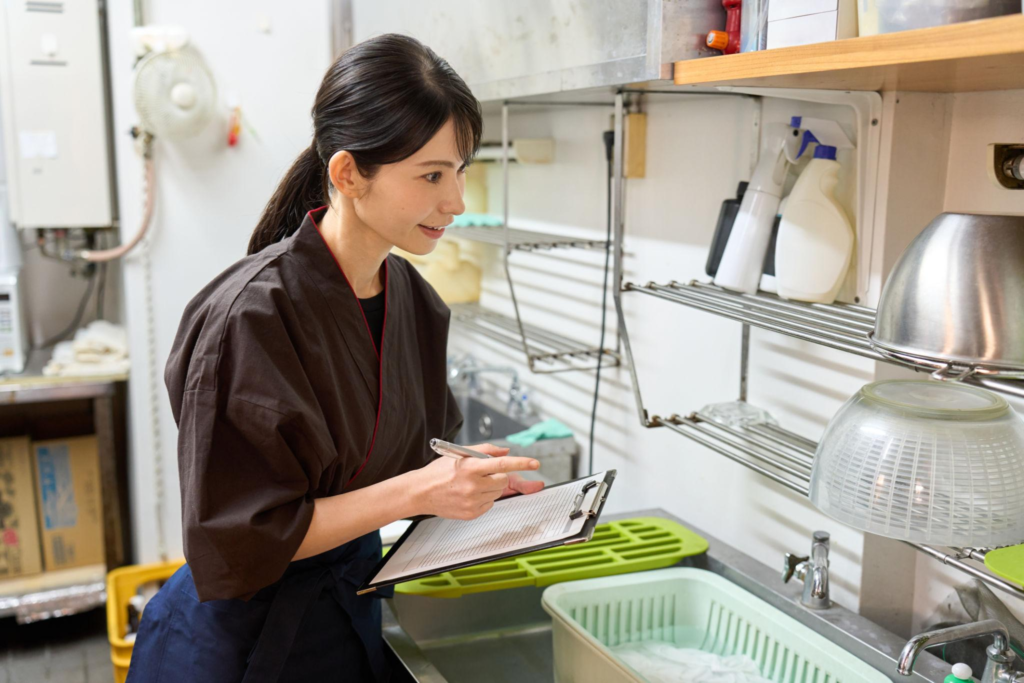
What Does ‘Commercial Kitchen Deep Clean Hygiene Solution’ Actually Mean?
The phrase gets used loosely. On some cleaning company websites it means an enhanced daily clean. In UK food safety compliance terms, it means something far more specific.
A genuine commercial kitchen deep clean hygiene solution is a systematic, fully documented cleaning programme that restores a kitchen to a bactericidal hygiene standard covering every surface, system, and piece of equipment to a level that daily cleaning cannot achieve and that satisfies the requirements of the Food Standards Agency, Environmental Health Officers, and commercial property insurers.
It is built on three pillars:
1. Surface and Equipment Hygiene
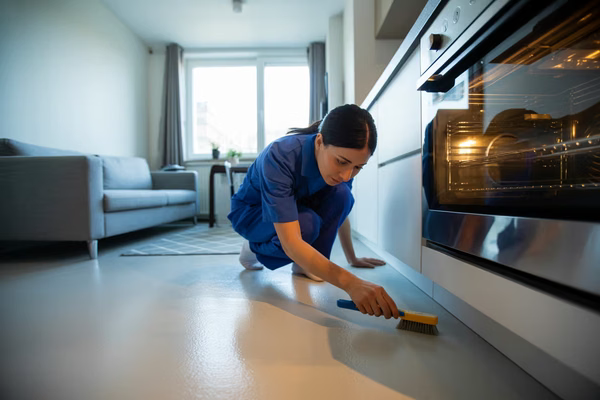
Every food contact surface, cooking appliance, refrigeration unit, and preparation area is cleaned and disinfected to bactericidal standards using COSHH-compliant products. The critical difference from daily cleaning: deep cleaning reaches inside equipment, beneath appliances, into drain channels, and along wall floor junctions the zones where grease, moisture, and organic matter accumulate and create bacterial risk.
2. Extraction System Cleaning to TR19 Standard
The extraction canopy, grease filters, ductwork runs, and extraction fans are degraded to the specification set out in TR19 the BESA (Building Engineering Services Association) standard for commercial ventilation hygiene. This is both a fire safety requirement and an insurance requirement. Grease accumulation in London restaurant extraction systems is the single leading cause of kitchen fires in the capital, and the most common reason a fire insurance claim is invalidated.
3. Documented Compliance Evidence
A professional deep clean hygiene solution produces a paper trail: TR19 certificate, COSHH product records, ATP swab test results, and a cleaning log. This documentation is what EHOs request, what insurers require, and what protects your business if your hygiene record is ever called into question.
Daily vs. deep clean the key distinction: Daily cleaning maintains the kitchen between services. Deep cleaning removes what daily cleaning leaves behind. Both are legally required. A kitchen that is cleaned daily but never deep cleaned will fail an EHO inspection because the grease in the extraction system, the carbonised residue inside the fryer, and the bacterial film on cold storage seals are invisible to the eye but detectable on a swab, and expected to be absent.
Commercial Kitchen Compliance The Legal Requirements for 2026
London food businesses operate under a layered compliance framework. These are not guidelines; they are the standards against which an EHO will assess your kitchen, and against which a commercial insurer will evaluate a claim.
Food Safety Act 1990
The baseline requirement: food premises must be kept clean, maintained in good repair, and structured to permit adequate cleaning. An EHO can issue an Improvement Notice or Emergency Prohibition Order shutting a business immediately if kitchen conditions fail this standard. In London, where EHO inspection frequency is among the highest in the UK, that risk is real and regular.
EC Regulation 852/2004 (Retained UK Law)
Post Brexit, this regulation remains part of UK domestic law. It requires that all food-handling areas are regularly cleaned and disinfected, food contact surfaces are maintained in sound condition, and that pest control and waste management are demonstrably in place. The word ‘regularly’ is assessed against cooking volume: a kitchen serving 200 covers a night is held to a higher frequency standard than one serving 40.
FSA Hygiene Rating System
The 0–5 star rating displayed on restaurant windows and the FSA’s public website is a direct output of EHO inspection. Ratings of 3 or below are visible to every potential customer and regularly cited on Google reviews and booking platforms. The most common causes of sub-3 ratings in London kitchens:
- Grease accumulation in extraction canopies and ductwork (TR19 non-compliance)
- Poor condition of cold storage bacterial growth in door seals and drain channels
- Floor and drain channel condition food debris and standing grease
- Inadequate disinfection of food preparation surfaces
- Structural evidence of pest access linked to hygiene failures
TR19: The Extraction Cleaning Standard
Published by BESA, TR19 defines the cleaning frequency and method required for commercial ventilation systems. It operates on a risk based model: cooking volume determines how often extraction systems must be professionally cleaned and certified from annually for low volume operations to monthly for high volume restaurant kitchens.
The compliance stakes: most London commercial kitchen insurance policies contain a specific clause requiring a current TR19 certificate as a condition of fire cover. A kitchen fire caused by grease build up in an extraction system without a current TR19 certificate is very likely uninsured. This is a financial exposure most operators are not aware of until a claim is made.
COSHH Regulations
Any cleaning company operating in a London commercial kitchen is legally required to use substances that are either not classified as hazardous under COSHH, or for which full risk assessments and data sheets are in place. Professional kitchen hygiene companies maintain COSHH documentation for every product they use and can provide this on request which EHOs are entitled to see.
📍 London context: Westminster, Tower Hamlets, Islington, Southwark, and Hackney councils conduct unannounced EHO inspections at significantly higher rates than the national average. The concentration of food businesses and high public footfall in London means kitchens face more scrutiny, more often, with less notice. A kitchen that meets minimum standards in a lower footfall area may not meet the effective standard applied in central London boroughs.
What a Professional Kitchen Deep Clean Covers Full Scope
Use this as your benchmark when evaluating any commercial kitchen cleaning service in London. A professional deep clean should cover every item in this table:
| Area / System | What Professional Deep Cleaning Includes | Compliance Relevance |
| Extraction canopy | Interior and exterior degreasing, filter removal and clean, canopy joints treated | TR19 standard fire safety and insurance |
| Ductwork runs | Section by section grease removal, access panel documentation, TR19 certificate issued | Legal fire safety requirement |
| Grease filters | Soak degreasing, rinse, reinstall frequency matched to cooking volume | TR19 and FSA rating |
| Commercial fryers | Full alkaline degrease of interior, tank scrub, exterior and burner clean | Fire risk, food quality, EHO compliance |
| Grills and griddles | Carbon removal with blade tools and steam, cooking surface restoration | Contamination prevention, FSA rating |
| Commercial ovens | Interior clean including racks, sides, door glass, burner surrounds | Hygiene rating, fire prevention |
| Cold storage units | Shelf and wall sanitisation, drain channel clean, door seal treatment | Listeria/Salmonella control primary EHO focus |
| Food prep surfaces | Bactericidal deep clean of all food contact surfaces and worktops | EC 852/2004 compliance |
| Commercial dishwasher | Filter, spray arms, door seal, interior walls descale and sanitise | Cross contamination prevention |
| Floors and drain channels | Full degreasing, drain channel cleared and sanitised, slip risk eliminated | EHO primary inspection point, H&S compliance |
| Walls and splashbacks | Grease film removal from all wall surfaces around cooking equipment | Hygiene rating, pest deterrence |
| ATP swab testing | Bioluminescence surface testing numerical pass/fail result documented | Objective EHO and insurance evidence |
💡 What ATP swab testing proves: An ATP test measures organic contamination bacteria, grease, food residue on a surface using bioluminescence, producing a numerical result in seconds. It is the only way to objectively verify that a surface is hygienically clean rather than visually clean. London EHOs increasingly request ATP documentation during inspections. A kitchen cleaning company that includes ATP testing is providing verifiable evidence, not just a service.
How Often Should a pepale Commercial Kitchen Be Deep Cleaned?
Most London kitchens are cleaned less frequently than the compliance framework assumes. Here is the honest frequency guide based on industry best practice and FSA assessment criteria:
| Area / System | Minimum Recommended Frequency | High Volume London Kitchen |
| Extraction canopy (TR19) | Annually | Every 3–6 months |
| Ductwork (TR19 certified) | Annually | Every 6 months |
| Commercial fryers | Monthly | Every 2 weeks |
| Grills and ovens | Quarterly | Monthly |
| Cold storage | Quarterly | Monthly |
| Floor and drain channels | Monthly | Every 2 weeks |
| Food prep surfaces | Weekly (professional grade) | Weekly or twice weekly |
| Full kitchen deep clean | Every 3–6 months | Monthly |
| ATP swab test | Annually | Quarterly |
EHOs assess cleaning frequency against actual cooking volume. A kitchen open seven days a week serving 100+ covers per service is expected to have a significantly more frequent deep clean schedule than these minimum figures. An EHO who finds a busy London restaurant kitchen with a single deep clean recorded in twelve months will note that as inadequate maintenance regardless of whether the daily cleaning record is spotless.
How to Choose a Professional Kitchen Cleaning Service in London
The London market for commercial kitchen cleaning contains a wide range of providers from genuinely certified, London based specialist teams to national cleaning companies with a London number and no London presence. Here is how to tell the difference.
Signals of a Trustworthy London Kitchen Cleaning Company
- A verifiable London address and deployed London teams. A phone number with a London area code does not mean a London team. Ask where the company’s operational base is, and whether the team cleaning your kitchen is based in London or travelling from outside the M25.
- TR19 certification provided as standard. After extraction cleaning, a professional service issues a TR19 certificate documenting the clean, the date, and the company. Ask specifically: ‘Do you provide a TR19 certificate?’ If the response is hesitation or a request to explain what TR19 is, that company cannot clean your extraction system to compliance standards.
- ATP swab testing offered. Objective surface testing is a marker of a company that stands behind its results. Visual cleanliness and measured cleanliness are not the same thing.
- Public liability insurance of at least £5 million. Commercial kitchen cleaning involves industrial chemicals, high temperature equipment, and gas appliances. Verify insurance in writing before any team enters your kitchen.
- COSHH data sheets available for every product used. A professional company can produce COSHH documentation on request. This is a legal requirement and a baseline quality indicator.
- Written specification and fixed pricing. A quote without a written cleaning specification is not a professional quote. Fixed pricing agreed in advance protects both parties and signals a company that knows exactly what the work involves.
Warning Signs to Watch For
Be cautious of any provider that quotes significantly below London market rates without explanation, cannot confirm TR19 certification capability, offers only verbal quotations, or whose listed address turns out to be a national call centre. The consequences of a failed EHO inspection, an invalidated insurance policy, or a kitchen fire caused by uncleaned extraction grease fall on the business owner not the cleaning company. The risk of choosing on price alone is entirely asymmetric.
What Does a Commercial Kitchen Deep Clean Cost in London? (2026 Pricing)
The following pricing reflects professional, certified kitchen deep cleaning using qualified teams, specialist equipment, COSHH-compliant products, and full compliance documentation. It does not reflect surface level cleaning sold as a deep clean.
| Service / Kitchen Type | Typical London Cost (2026) | What’s Included |
| Small café or sandwich bar | £200–£400 | Full deep clean, all equipment, documentation |
| Medium restaurant (40–80 covers) | £400–£800 | Deep clean plus extraction and cold storage |
| Large restaurant (80–150 covers) | £700–£1,400 | Full scope, all systems, TR19 and ATP |
| Hotel or events kitchen | £800–£2,500 | Scale dependent, full documentation |
| Dark kitchen / delivery-only | £350–£700 | Equipment and extraction focused |
| Extraction canopy only (TR19) | £300–£900 | TR19 certificate issued |
| Ductwork cleaning (TR19) | £500–£1,500 | Dependent on duct run length and complexity |
| Monthly maintenance contract | £200–£800/month | Agreed scope and frequency, documented |
| Emergency / same day clean | £500–£2,000+ | Urgency premium, all London boroughs |
The frame that matters: the cost of a professional kitchen deep clean sits far below the cost of what it prevents. An EHO improvement notice, a temporary closure order, a rejected insurance claim, or a fire caused by extraction grease are all materially more expensive financially and reputationally than a regular deep clean schedule. For any London food business, this is not a discretionary spend.
Commercial Kitchen Deep Cleaning Across Every London Borough
Safa Cleaning Services is based at 124 City Road, London EC1V 2NX. We deploy cleaning teams across every London borough, seven days a week, with genuine same day emergency availability not a forwarding number.
Central London: City of London, Westminster, Holborn, Clerkenwell, Farringdon, Barbican, Moorgate, Shoreditch.
East London: Hackney, Bethnal Green, Stratford, Canary Wharf, Tower Hamlets, Bow, Poplar, Greenwich.
North London: Islington, Camden, Stoke Newington, Highbury, Finsbury Park, Holloway, Archway.
South London: Southwark, Bermondsey, Lewisham, Brixton, Clapham, Peckham, Croydon, Dulwich.
West London: Kensington, Chelsea, Hammersmith, Chiswick, Ealing, Shepherd’s Bush, Notting Hill.
Every commercial kitchen job includes: TR19 documentation where applicable, COSHH product records, ATP swab results, a cleaning completion report, and our 100% satisfaction guarantee. No hidden costs, no vague scopes, a written specification agreed in advance.
Our full commercial cleaning services in London cover offices, retail, healthcare facilities, and commercial kitchens. Our specialist kitchen cleaning services page details the full scope of what a certified kitchen hygiene programme involves.
🍳 Book a Certified London Commercial Kitchen Deep CleanSafa Cleaning Services | 124 City Road, London EC1V 2NX | All London Boroughs | Same Day Emergency Available | TR19 + ATP Documentation ProvidedRequest your free kitchen hygiene assessment and fixed quote →
Frequently Asked Questions
What is a deep clean hygiene solution for a commercial kitchen?
A deep clean hygiene solution is a comprehensive, professionally delivered cleaning programme that restores a commercial kitchen to a bactericidal hygiene standard across all surfaces, systems, and equipment including extraction ductwork, cooking appliances, cold storage, and floor drain channels. It goes beyond daily operational cleaning to address the contamination that routine cleaning cannot reach, and produces documented evidence of compliance for EHO and insurance purposes.
What are the legal deep clean requirements for London commercial kitchens?
London food businesses must comply with: the Food Safety Act 1990 (kitchen cleanliness and maintenance), EC Regulation 852/2004 (food hygiene for food handlers), FSA Hygiene Rating System standards, TR19 (extraction system cleaning frequency and certification), and COSHH Regulations governing the use of cleaning chemicals. Environmental Health Officers have authority to issue Improvement Notices or Emergency Prohibition Orders for non-compliance, and can close a business on the same day as an inspection.
How much does a commercial kitchen deep clean cost in London in 2026?
Costs in 2026 range from £200–£400 for a small café to £700–£1,400 for a large restaurant (80–150 covers), with TR19 extraction canopy cleaning priced separately at £300–£900 including certificate. Monthly maintenance contracts run from £200–£800 depending on scope. Emergency same day cleans in London carry a premium and start from approximately £500. These figures reflect professional services with full documentation not surface cleaning sold as a deep clean.
How do you deep clean a commercial kitchen professionally?
A professional deep clean follows a systematic sequence: extraction canopy and ductwork degreasing (TR19), commercial fryer carbon removal, grill and griddle surface restoration, oven full interior clean, cold storage sanitisation including door seals and drain channels, food preparation surface bactericidal treatment, commercial dishwasher descaling, floor and drain channel degreasing, and wall and splashback cleaning. ATP swab testing is conducted at completion to verify bactericidal hygiene standards and produce documented evidence for compliance records.
How often does a London commercial kitchen need a professional deep clean?
Extraction systems must be cleaned to TR19 standard annually at minimum quarterly or more often for high volume kitchens. Full kitchen deep cleans should occur every three to six months for most London restaurants, with monthly deep cleans for high volume operations. EHOs assess deep clean frequency against cooking volume, not just calendar frequency; a busy kitchen with a once yearly deep clean record is considered inadequately maintained regardless of its daily cleaning log.
What is TR19 and why does my London kitchen need it?
TR19 is the BESA standard for commercial kitchen ventilation system cleaning. It defines the required cleaning frequency (based on cooking volume and equipment type), the cleaning method, and the documentation required. Most London commercial property insurance policies require a current TR19 certificate as a condition of fire cover. An extraction system fire without a current TR19 certificate is likely to result in an invalidated claim. EHOs also assess extraction system conditions during hygiene inspections and reference TR19 compliance in scoring.
What should I look for in a professional kitchen cleaning service in London?
Look for: a physically London based company with London deployed teams (not just a London phone number), explicit TR19 certification capability with certificate provided after each extraction clean, ATP swab testing as part of the service, public liability insurance of at least £5 million, COSHH-compliant products with data sheets available on request, and a written cleaning specification with fixed pricing agreed before work begins. Safa Cleaning Services meets all of these requirements from our base at 124 City Road, London EC1V 2NX.
What is the difference between daily kitchen cleaning and a commercial deep clean?
Daily kitchen cleaning maintains operational hygiene between services: wiping surfaces, mopping floors, washing dishes and equipment. A commercial deep clean removes the contamination that daily cleaning cannot reach and does not address: grease deposits in extraction ductwork, carbonised residue inside fryers and grills, bacterial build up in cold storage seals and drain channels, and grease accumulation in floor wall junctions. Both are required by law. A kitchen with only daily cleaning on record and no documented deep clean programme will not pass an EHO inspection in 2026.
Does Safa Cleaning Services cover my area of London?
Yes. We cover every London borough from our operational base at 124 City Road, London EC1V 2NX including all of central, east, north, south, and west London. We deploy teams seven days a week with same day availability for genuine kitchen emergencies. Every job includes a written completion report and full compliance documentation.
How do I book a commercial kitchen deep clean in London?
Contact Safa Cleaning Services directly via our contact page. We provide a free kitchen hygiene assessment, a written cleaning specification, and a fixed price quote with no obligation. For urgent or same day requirements, call us directly and we cover all London boroughs and can often mobilise the same day. All commercial kitchen jobs include TR19 documentation where applicable and ATP swab testing results.
Deep Clean Hygiene Solutions That Protect Your London Kitchen Business
London’s food safety compliance environment in 2026 is tighter, better monitored, and less forgiving than it has ever been. EHO inspections happen without notice. Hygiene ratings are publicly visible and commercially significant. Insurance policies contain conditions most operators have not read carefully enough. And the most common cause of commercial kitchen fires grease build up in extraction systems is entirely preventable with a proper, certified deep clean schedule.
The right commercial kitchen deep clean hygiene solution is not the cheapest service you can find online. It is the one that covers every system, produces full TR19 and compliance documentation, is delivered by a team that genuinely operates in London and leaves your kitchen in a condition you can demonstrate to an EHO.
Safa Cleaning Services has been cleaning London commercial kitchens to compliance standard from 124 City Road, EC1V 2NX. Our commercial cleaning services and specialist kitchen cleaning services are built on documented results not promises.
📞 Book your London commercial kitchen hygiene assessment today →